


CNC Porn Explained What Consensual Non-Consent Actually Means

Image created using advanced AI technology, professionally refined by MyPornBible editorial team.
CNC is one of the most searched and most misunderstood kinks in porn. This guide covers what it is, why people enjoy it, how to practice it safely, and how to tell the difference between ethical CNC content and content that crosses the line.
What Is CNC (Consensual Non-Consent)?
CNC stands for Consensual Non-Consent — a BDSM practice where all parties agree in advance to act out a scenario that simulates non-consensual sex. The "consensual" part is the foundation: every aspect is negotiated, planned, and agreed upon before anything happens. The "non-consent" part is pure role-play.
In practice, CNC involves one partner playing a dominant/aggressor role and the other playing a resistant/submissive role within a pre-negotiated scene. The submissive may say "no" or "stop" as part of the fantasy, but a separate safe word or signal exists to genuinely end the scene at any moment.
CNC sits within the broader BDSM spectrum alongside bondage, dominance/submission, and sadomasochism. It is one of the most intense power exchanges because it involves simulating the loss of control rather than just physical restraint. The emotional stakes are higher, which is exactly why it requires more preparation and trust than most other kinks.
Why Do People Enjoy CNC?
Why people enjoy CNC
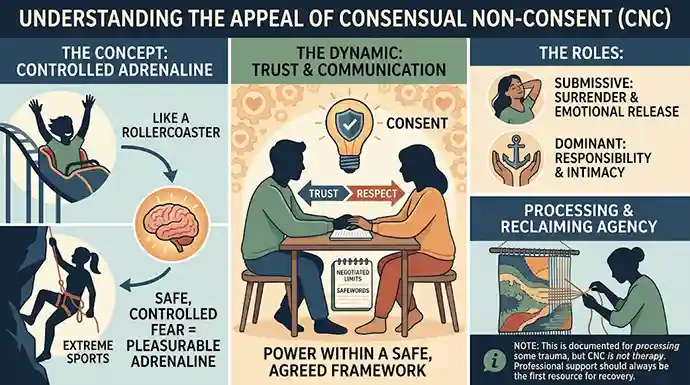
People enjoy CNC for the same reasons people enjoy horror movies, roller coasters, and extreme sports — the controlled experience of fear and vulnerability produces an adrenaline rush that the brain processes as intensely pleasurable when you know you are actually safe.
For the Submissive Partner
The appeal is often about complete surrender of control. In a safe, consensual context, the submissive can experience the psychological intensity of powerlessness without any actual danger. Many submissives report that CNC allows them to reach a headspace of total vulnerability that produces uniquely intense arousal and emotional release.
For the Dominant Partner
The dominant experiences total power and intensity within a framework of trust. The knowledge that their partner has granted them this level of control — and trusts them completely to stay within negotiated limits — creates a form of intimacy that vanilla sex rarely achieves. The responsibility itself is part of the appeal.
This reversal of expected power roles is a theme across many kinks — pegging, for example, flips the penetrative dynamic in heterosexual couples in a way that creates a similar intensity of trust and vulnerability. Our guide on what is pegging explores how couples navigate that power exchange.
For Trauma Processing
Some people who have experienced sexual trauma use CNC as a way to reclaim agency over scenarios that were previously out of their control. This is documented in psychology literature — re-enacting difficult experiences in a safe, controlled environment can be a form of processing. This does not mean CNC is therapy, and professional support should always be the first resource for trauma recovery.
CNC vs Actual Assault: The Critical Difference
The difference between CNC and sexual assault is explicit, informed, enthusiastic prior consent. CNC is negotiated before the scene begins, includes safe words that can stop everything instantly, and both partners walk in knowing exactly what will happen and what will not.
Actual assault involves zero prior agreement, no safe words, and no way out. There is no overlap between these two things. Anyone who claims CNC as a defense for non-consensual acts is lying — CNC requires more communication and planning than any other sexual practice, not less.
The BDSM community treats this distinction as absolute and non-negotiable. Consent is not a spectrum in CNC — it is either fully present with clear boundaries, safe words, and mutual enthusiasm, or the activity is not CNC. There is no grey area.
Legitimate CNC always includes: sober negotiation beforehand, agreed-upon safe words or signals, clearly defined boundaries (what is and is not allowed), the ability to stop the scene at any moment, and aftercare protocols. If any of these elements are missing, it is not CNC.
Safe Words, Signals, and Negotiation
Safe words and negotiation
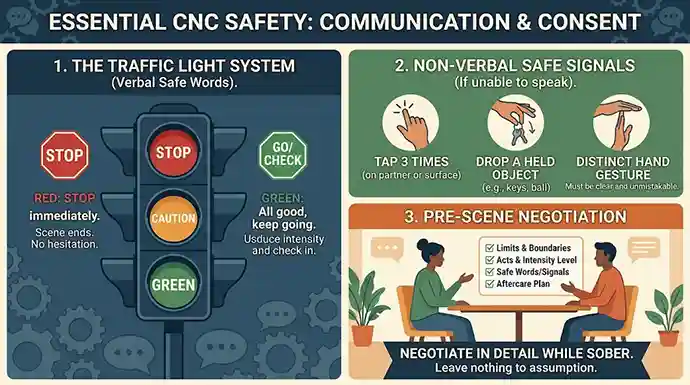
Safe words are the single most important element of CNC. Because the scene involves saying "no" and "stop" as part of the role-play, you need a completely separate word that means "this is real, end the scene immediately." The most common system is the traffic light model.
The Traffic Light System
"Red" means stop everything immediately. The scene ends, restraints come off, the dominant drops character instantly. No questions, no hesitation, no "are you sure?" — red means done.
"Yellow" means slow down or ease up. Something is approaching a limit but the submissive does not want to end the scene entirely. The dominant should reduce intensity, check in, and adjust.
"Green" means everything is good, keep going. This is useful as a check-in tool — the dominant can ask "color?" at any point and get an instant status update.
Non-Verbal Safe Signals
If the scene involves gagging or anything that prevents speech, a physical safe signal is essential. Common options include dropping a held object (a ball or set of keys), tapping three times on the partner or a surface, or a specific hand gesture. The signal must be unmistakable and impossible to confuse with scene behavior.
Pre-Scene Negotiation
Every CNC scene should be negotiated in detail while both partners are sober and in a non-sexual setting. The conversation covers what acts are included, what is absolutely off-limits, what intensity level is desired, how long the scene will last, and what aftercare will look like. Nothing should be left to assumption.
How to Practice CNC Safely
Safe CNC requires more preparation than any other sexual activity. The intensity of the fantasy demands proportionally intense safety measures. Rushing into CNC without proper groundwork is dangerous for both partners.
Start Small
Do not jump into full CNC scenarios on your first attempt. Begin with light power exchange — pinning wrists, verbal dominance, controlled resistance. Build up gradually over multiple sessions as trust develops and you learn each other's responses.
Establish Trust First
CNC should only happen between partners who already have deep trust and communication. This is not a first-date activity. You need to know how your partner handles stress, how they communicate under pressure, and whether they will absolutely honor a safe word without hesitation.
The same trust-first principle applies to every advanced sexual practice that involves multiple people or intense dynamics. Our swinger lifestyle guide covers how couples in the swinging community use similar negotiation and boundary-setting protocols to keep their experiences safe.
Sober Only
Never practice CNC under the influence of alcohol or drugs. Substances impair judgment, pain perception, and the ability to communicate safe words. CNC requires maximum awareness from both partners at all times.
Aftercare Is Mandatory
Aftercare is not optional in CNC — it is a required part of the experience. After an intense scene, both partners need physical comfort (blankets, water, holding), emotional check-ins, and reassurance. The submissive may experience "sub drop" (emotional crash) hours or days later. The dominant may experience guilt or emotional overload. Aftercare addresses both.
CNC in Porn: Staged Fantasy vs Reality
CNC porn is entirely staged and choreographed, just like every other genre. The performers negotiate the scene beforehand, safe words are in place off-camera, and the "resistance" you see is acting. Professional CNC content is no more real than a Jason Statham fight scene is a real fistfight.
The production side involves detailed pre-shoot discussions about what acts will be performed, what the intensity level will be, and where the boundaries lie. Reputable studios like Kink.com include on-screen pre-scene and post-scene interviews showing the performers discussing consent and confirming they enjoyed the experience.
The danger with CNC porn is that not all producers are ethical. Some content presents non-consensual scenarios without any context about the negotiation and consent that happened off-camera. This can normalize the idea that CNC-style encounters happen spontaneously, which is fundamentally false and dangerous.
Look for studios that show pre-scene and post-scene interviews, list performer consent protocols in their terms, and have transparent content policies. Kink.com pioneered this transparency in BDSM porn. If a site shows extreme content with no context about consent, approach it with skepticism.
The Psychology Behind CNC Fantasies
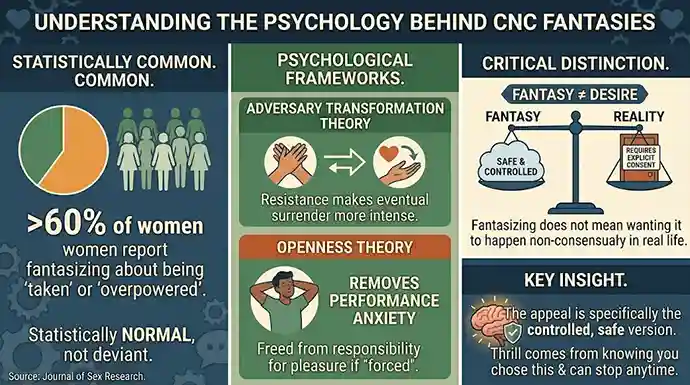
CNC psychology
CNC fantasies are among the most common sexual fantasies globally, particularly among women. Research published in the Journal of Sex Research found that over 60% of women reported having fantasized about being "taken" or "overpowered" sexually at least once. Having the fantasy is statistically normal, not deviant.
Psychologists explain this through several complementary frameworks. The "adversary transformation" theory suggests that the fantasy appeals because resistance makes eventual surrender more psychologically intense. The "openness" theory posits that the fantasy removes performance anxiety — if you are being "forced," you are free from responsibility for your own pleasure.
The key insight from research is that fantasy does not equal desire. Fantasizing about a CNC scenario does not mean wanting it to happen non-consensually in real life. The appeal is specifically the controlled, safe version — the thrill comes from knowing you chose this and can stop it anytime.
Is CNC Legal?
The legality of CNC is complicated and varies significantly by jurisdiction. In many countries, consent to assault is not a valid legal defense — meaning that even if both parties agreed beforehand, the physical acts involved in CNC could technically be prosecuted if reported.
In the United States, BDSM-related activities exist in a legal grey area. Consent is generally a valid defense against assault charges, but prosecutors can and occasionally do pursue cases involving BDSM injuries. The law has not caught up with the reality of consensual kink practice.
In the UK, the landmark R v Brown (1993) case established that consent is not a defense to actual bodily harm in a sexual context, even between willing adults. This ruling technically makes much of BDSM practice illegal in the UK, though prosecution is rare for private consensual activities.
The practical advice is to keep written records of consent discussions (text messages negotiating the scene work well), use safe words consistently, and understand your local laws. The BDSM community recommends consulting resources from organizations like the National Coalition for Sexual Freedom for jurisdiction-specific legal guidance.
Common Misconceptions About CNC
"CNC Is Just an Excuse for Abuse"
This is the most harmful misconception. Legitimate CNC requires more communication, planning, and mutual respect than any vanilla sexual encounter. Abusers who claim CNC as cover are not practicing CNC — they are committing assault and lying about it. The BDSM community actively works to identify and exclude these individuals.
"Only Damaged People Want CNC"
Research consistently shows that BDSM practitioners are no more likely to have mental health issues than the general population. A 2013 study in the Journal of Sexual Medicine found that BDSM practitioners actually reported lower levels of psychological distress, higher subjective well-being, and better communication in relationships compared to non-practitioners.
"The Submissive Has No Power"
The submissive in CNC holds the most important power — the safe word. They can end the scene instantly at any time. The dominant operates within boundaries set by the submissive. In well-practiced CNC, the submissive is actually the one defining the limits of the entire experience.
"Watching CNC Porn Means You Want to Do It in Real Life"
Watching CNC porn does not mean you want non-consensual encounters. Fantasy consumption and real-world desires are separate psychological domains. Millions of people watch horror movies without wanting to be murdered. The same logic applies to sexual content.
Is CNC Right for You?
CNC may be right for you if you are in a high-trust relationship with excellent communication, you have experience with lighter BDSM activities, and you find the concept of power exchange arousing rather than distressing. It is not a beginner activity and should never be your first experience with kink.
If CNC interests you, start by reading and discussing — not by doing. Talk to your partner about the concept. Read guides from established BDSM educators. Watch ethical CNC content together to gauge your reactions. The conversation itself is the first step, and many couples find that talking about it is enough to determine whether they want to go further.
If you are exploring CNC through porn, choose ethical producers that show transparent consent practices. Understand that what you see on screen is choreographed performance, not a blueprint for real-life practice. The gap between porn and reality is wider in CNC than in almost any other genre.
CNC is an advanced kink that rewards patience and preparation. Done right, it creates uniquely intense experiences built on trust and vulnerability. Done wrong, it causes genuine harm. The difference is always the same: communication, consent, and care.
For more recommendations across every niche, check out our best porn sites directory — updated regularly with the latest reviews and rankings.