Image created using advanced AI technology, professionally refined by MyPornBible editorial team.
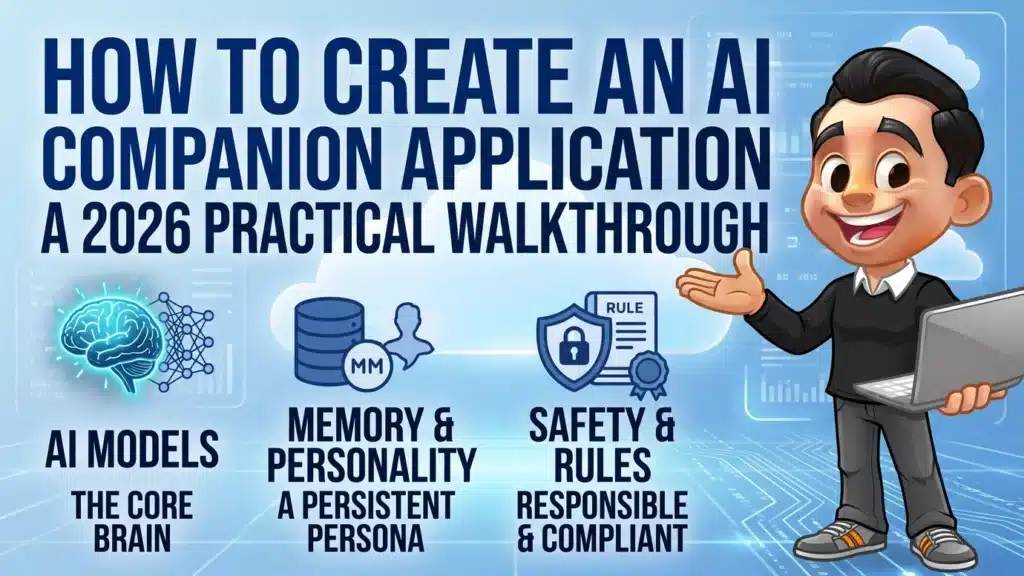
A clear, practical walkthrough of how AI companion apps are actually built in 2026 — the core components, the models, the memory and personality systems, and the safety and legal rules that keep a product responsible.
6
Build Steps
3
Core Layers
18+
Adults Only
2026
Updated
Section 01
What Is an AI Companion App?
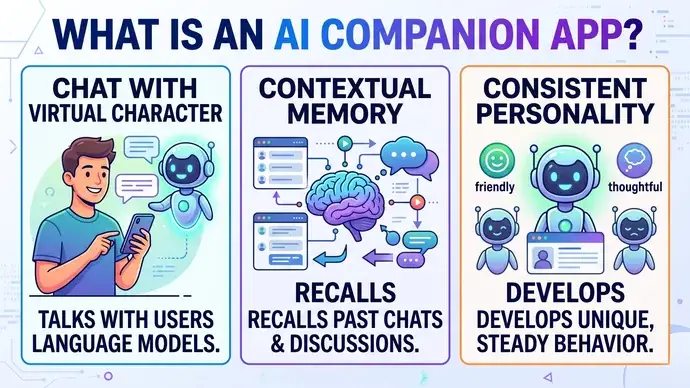
An AI companion app is software that lets users chat with a virtual character powered by a large language model. The character holds conversations, remembers context, and develops a consistent personality over time.
These apps range from friendly chatbots to romantic or adult companions. The core idea is the same: a persistent AI persona that feels personal and responsive to each user.
What separates a companion from a basic chatbot is memory and personality. A companion recalls past chats and behaves consistently, which is what makes the relationship feel real to users.
The Short Answer
An AI companion app is a persistent AI persona built on a language model, wrapped in memory, personality, and a user interface. The model talks; the surrounding systems make it feel like someone.
What an AI companion app is
Section 02
What Are the Core Components?
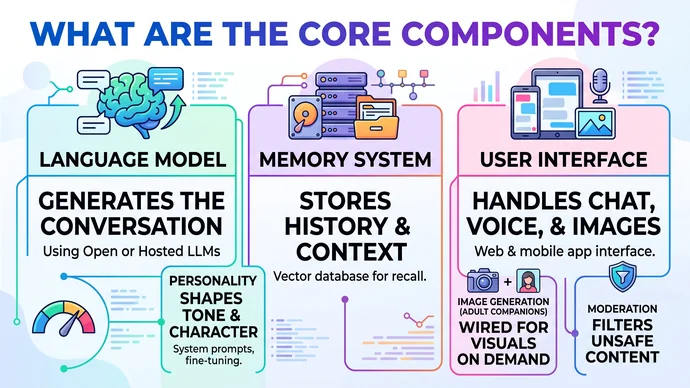
An AI companion app is built from three core layers: a language model, a memory system, and a user-facing interface. Together these turn raw AI output into a consistent, personal experience.
The model generates responses, the memory layer stores context and history, and the interface handles chat, voice, or images. Most products also add a personality layer that shapes tone and behavior.
Layer
What It Does
Example Tech
Language model
Generates the conversation
Open or hosted LLM
Memory
Stores history and context
Vector database
Personality
Shapes tone and character
System prompt, fine-tuning
Interface
Chat, voice, or image UI
Web or mobile app
Moderation
Filters unsafe content
Safety classifier
For an adult companion, image generation is often part of the interface layer. The same models behind today's leading AI image platforms can be wired into a companion to produce visuals on demand.
If you want the visual side to go beyond static images, our guide on how to create an AI porn generator covers the diffusion pipeline for text-to-image and text-to-video — the same technology you would integrate into a companion's image layer.
The core layers of a companion app
Section 03
How Do You Build One Step by Step?
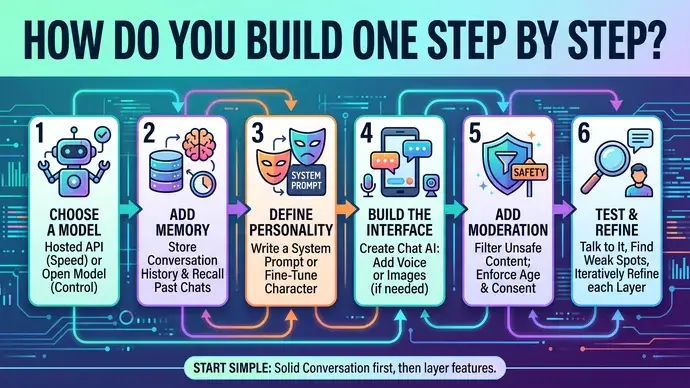
You build an AI companion app by choosing a model, adding memory, defining a personality, building the interface, adding moderation, and then testing. The whole loop is iterative, so you refine each layer as you go.
Start simple with a working chat loop before adding advanced features. Get one solid conversation working first, then layer on memory, voice, and images.
The Six-Step Build
Choose a model. Pick a hosted API for speed or an open model for control and privacy.
Add memory. Store conversation history so the companion recalls past chats.
Define personality. Write a system prompt or fine-tune the model for a consistent character.
Build the interface. Create a chat UI, and add voice or images if needed.
Add moderation. Filter unsafe content and enforce age and consent rules.
Test and refine. Talk to it, find weak spots, and iterate on each layer.
Each step builds on the last, so resist the urge to add everything at once. A simple companion that works beats a complex one that breaks.
The six-step build process
Section 04
How Do You Give It Personality and Memory?
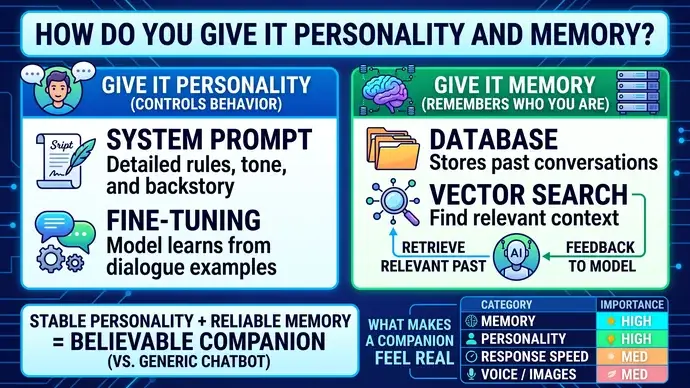
You give an AI companion personality with a detailed system prompt and memory with a database that stores past conversations. Personality controls how it behaves; memory lets it remember who the user is.
A system prompt describes the character's tone, backstory, and rules in plain language. For deeper consistency, developers fine-tune the model on example dialogue that matches the persona.
How does AI memory actually work?
Memory works by saving past messages and retrieving the relevant ones before each reply. Most apps use a vector database to find earlier context that matches the current conversation, then feed it back to the model.
Why does personality consistency matter?
Consistency is what makes a companion feel real instead of random. A stable personality plus reliable memory is the difference between a believable companion and a generic chatbot.
What Makes a Companion Feel Real
Memory
High
Personality
High
Response speed
Med
Voice / images
Med
How personality and memory work
Section 05
What Safety and Legal Rules Apply?
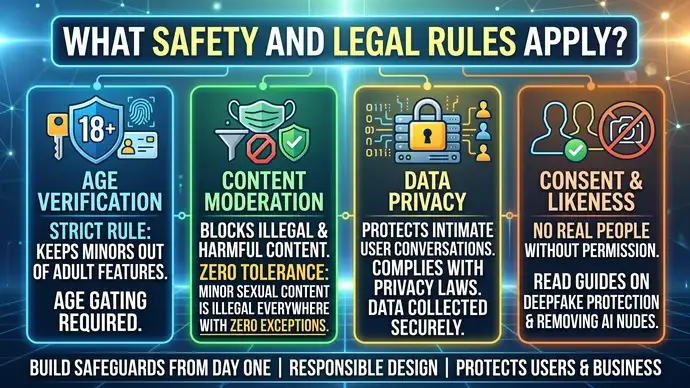
An AI companion app must enforce strict age verification, content moderation, and data privacy rules. These are not optional, especially for any app with adult or romantic features.
Age gating keeps minors out, and moderation filters block illegal or harmful content. Any sexual content involving minors is illegal everywhere, including AI-generated material, with zero exceptions.
Privacy law also applies, since companion apps collect intimate conversations. If your app touches real people's likenesses, read our guide to Deepfake Protection & Removing AI Nudes before launch.
Requirement
Why It Matters
Age verification
Keeps minors out of adult features
Content moderation
Blocks illegal and harmful output
Data privacy
Protects intimate user data
Consent & likeness
No real people without permission
Build these safeguards in from day one rather than bolting them on later. Responsible design protects both your users and your business.
The safety and legal rules that apply
Section 06
What Are the Most Common Beginner Mistakes?
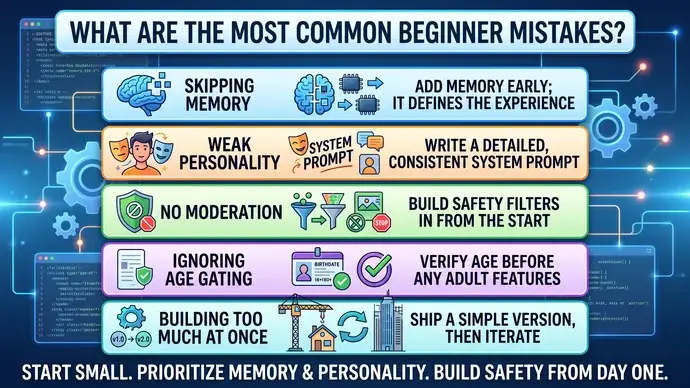
Most first-time builders make a few avoidable mistakes. Knowing them in advance saves time, money, and legal headaches.
Mistake
What To Do Instead
Skipping memory
Add memory early; it defines the experience
Weak personality
Write a detailed, consistent system prompt
No moderation
Build safety filters in from the start
Ignoring age gating
Verify age before any adult features
Building too much at once
Ship a simple version, then iterate
The bottom line is simple: start small, prioritize memory and personality, and build safety in from day one. Get those right and you have a solid foundation. For a look at how AI is reshaping interactive adult media, see our roundup of the Best Porn Games.
Common beginner mistakes to avoid
Section 07
Frequently Asked Questions
Do you need to know how to code to build an AI companion?
You need some coding ability to build a custom AI companion, though no-code and low-code platforms are lowering that barrier. Connecting a model, a memory database, and an interface still benefits from basic programming knowledge.
How much does it cost to build an AI companion app?
Costs vary widely depending on whether you use a hosted API or self-host a model. Hosted models charge per use and scale with traffic, while self-hosting requires upfront hardware but lowers long-term per-message cost.
What model is best for an AI companion?
The best model depends on your priorities: hosted APIs offer quality and ease, while open models offer control and privacy. Many adult companions use open models specifically because they allow uncensored, self-hosted deployment.
Is it legal to build an adult AI companion?
Building an adult AI companion for fictional adult characters is generally legal, but it requires strict age gating and moderation. Content involving minors or real people without consent is illegal, so safeguards are mandatory.
Section 08
Key Takeaways
What To Remember
Three core layers run the show. A language model, a memory system, and an interface form the backbone of any companion app.
Memory and personality make it real. They are what separate a believable companion from a generic chatbot.
Build iteratively. Get one solid conversation working, then add memory, voice, images, and polish.
Safety is mandatory. Age gating, moderation, and privacy protections belong in the design from day one.
The takeaway is simple: master the three core layers, prioritize memory and personality, and build safety in from the start. Do that and you have a companion app worth shipping. For more honest guides and reviews across every niche, explore the best porn sites.